
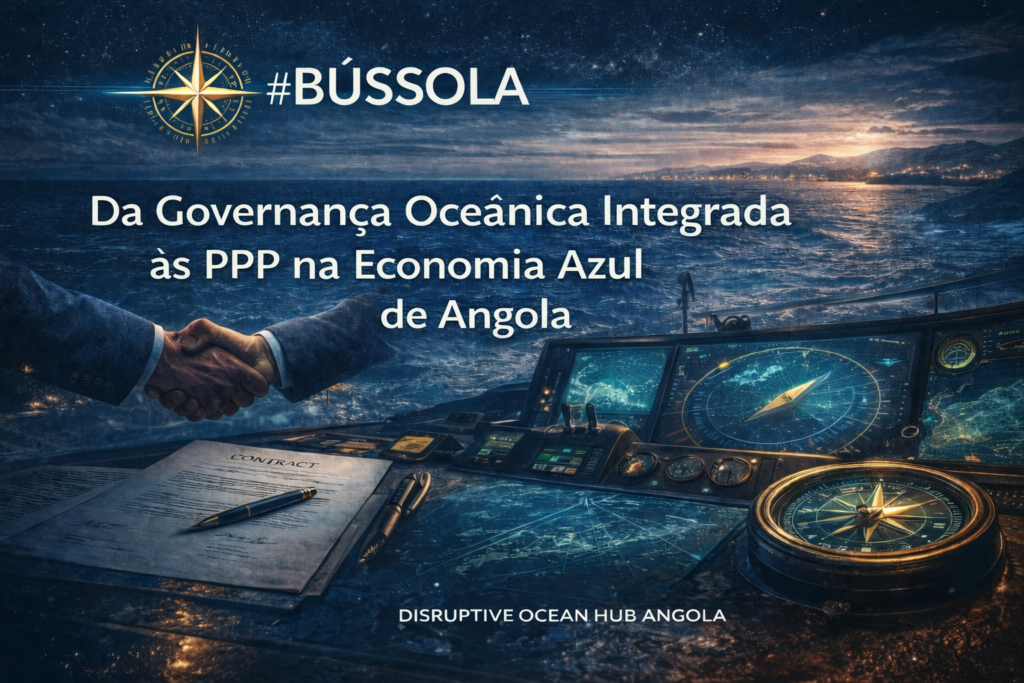
When Policy Instruments Run Ahead of Governance
The blue economy has increasingly established itself in international discourse as an emerging paradigm for sustainable development in coastal states of the Global South, promising a reconciliation between economic growth, environmental protection, and social inclusion.
However, a growing body of critical literature highlights that this normative framework coexists with deep structural tensions related to power, benefit distribution, and the reproduction of pre-existing economic models (Silver et al., 2015; Bennett et al., 2019).
In Angola, the operationalisation of the blue economy has occurred primarily through Public–Private Partnerships (PPPs) and large-scale flagship projects, often supported by foreign capital, technology, and technical expertise.
This trajectory raises a central analytical question: are we building a blue economy, or merely changing the colour of an old development model?
The Angolan experience suggests a significant mismatch between implementation instruments and the governance framework that should guide them. Put simply, the operational mechanisms of the blue economy are advancing faster than the institutional consolidation of maritime governance. This misalignment undermines strategic coherence, weakens political legitimacy, and limits the social sustainability of adopted policies.
Drawing on the concept of Integrated Ocean Governance (IOG), this article analyses the use of PPPs in Angola’s blue economy through the lenses of Political Science and International Relations.
The core argument is straightforward: in the absence of a robust IOG framework, PPPs tend to reinforce state-centric, extractive, and asymmetric logics, rather than enabling structural transformation and broad-based inclusion (Hodge & Greve, 2016; Bennett et al., 2019).
Integrated Ocean Governance Is More Than Administrative Coordination
Integrated Ocean Governance (IOG) has consolidated itself as a normative and operational reference for coastal states seeking to transform the ocean into a vector of sustainable, sovereign, and inclusive development. Its relevance lies in its ability to articulate fragmented policies, align governance scales, and integrate economic, environmental, and social dimensions.
In the South Atlantic, IOG also carries a clear geopolitical dimension. The literature on ocean governance and International Relations underscores that the capacity to translate science and data into norms, agendas, and shared positions is a key element of regional political assertion (Blasiak et al., 2020; Lombard et al., 2023).
It is within this framework that the analysis of PPPs becomes unavoidable. Conceptually, IOG should precede policy instruments. PPPs should function as tools subordinated to a previously defined strategic framework. The problem emerges when this hierarchy is reversed.
In Angola, there is a dynamic in which public policy instruments appear to precede the consolidation of the governance framework, thereby conditioning priority-setting and institutional arrangements. When this occurs, PPPs cease to implement policy and begin to define it.
In simple terms: when governance arrives late, instruments start shaping policy.
PPPs in the Blue Economy: Technical Tools or Power Devices?
Contemporary scholarship has long abandoned the view of PPPs as merely technical solutions. Today, they are understood as hybrid forms of governance with direct implications for the distribution of power, risks, and benefits between public and private actors (Hodge & Greve, 2017; Bayliss & Van Waeyenberge, 2018).
In strategic sectors such as the oceans, PPPs influence not only policy implementation, but also the definition of national priorities, control over critical assets, data governance, and even the delimitation of the public interest.
Within the blue economy context, this sensitivity is amplified. As noted by Bridge et al. (2018) and Bennett et al. (2019), the framing of the blue economy as a “win–win” solution often conceals processes of nature financialisation and the displacement of decision-making power towards actors with greater financial and technological capacity.
In Global South contexts, these asymmetries are not marginal — they are structural, and they shape policy outcomes.
When Instruments Shape Governance
The Angolan experience reveals a persistent tension between strategic ambition and institutional capacity. The accelerated adoption of PPPs is taking place in a context where IOG remains fragmented.
The outcome is clear: instruments cease to execute policy and begin to influence the very architecture of governance. From a Political Science perspective, this inversion reduces the State’s ability to act as a strategic arbiter and increases the risk of regulatory capture, particularly in contexts marked by technological, financial, and informational asymmetries (Bayliss & Van Waeyenberge, 2018; Mazzucato, 2018).
In other words, policy adapts to projects, rather than projects responding to policy.
The question thus becomes unavoidable: who governs the blue economy when the rules are still under construction?
The National Private Sector and the Limits of Institutional Design
The limited participation of national private actors in Angola’s blue economy is often attributed to technical or financial constraints. This explanation is insufficient.
In many cases, a state-centric logic of political risk management prevails, favouring large-scale projects and a small number of interlocutors — often foreign — perceived as administratively more predictable. Smaller national initiatives require greater regulatory capacity and institutional coordination, making them politically less attractive.
Moreover, the blue economy continues to be conceptualised as an extension of the extractive economy. Models based on concessions, productive enclaves, and anchor projects persist, despite the sustainability and innovation rhetoric.
The absence of intermediate public policy instruments exacerbates this scenario. Blue innovation funds, maritime incubators, or small-scale concessions remain underdeveloped. Institutional design effectively recognises only two actors: the State and the large foreign partner. The national private sector is left in between, without a clear place.
The Social Vector: The Frequently Overlooked Variable That Destabilises Everything
Normatively, the blue economy is associated with social inclusion and the recognition of coastal communities as central actors in maritime governance. When this dimension is marginalised, three elements are lost simultaneously: political legitimacy, environmental sustainability, and strategic coherence.
Sustainability cannot be imposed by contract. It is built through belonging. It depends on participation processes, social appropriation, and political recognition.
Without these elements, governance tends to assume a technocratic character, with limited territorial impact.
Sovereignty, Power, and the Future of the South Atlantic
Without a robust IOG framework, PPPs become asymmetric, the national private sector remains peripheral, and the social dimension of the blue economy loses centrality. From an International Relations perspective, this scenario constrains Angola’s ability to translate ocean science and data into normative power and regional projection.
Knowledge without institutions does not translate into influence.
The blue economy thus emerges less as a technical or financial challenge and more as a fundamentally political choice. The ocean can become a vector of strategic autonomy and sovereign affirmation — or, conversely, a new frontier of dependency and decision externalisation.
The difference lies, fundamentally, in the adopted governance model and in the State’s capacity to structure institutional arrangements that articulate environmental sustainability, social inclusion, and strategic power (Silver et al., 2015; Bennett et al., 2019).
Conclusion
From a strategic orientation perspective, the blue economy in Angola will only move beyond a mere change of colour over an old model when it rests on three pillars:
a) First, an Integrated Ocean Governance framework that precedes and frames policy instruments, ensuring that PPPs operate as means rather than ends.
b) Second, the creation of intermediate instruments capable of integrating the national private sector.
c) Third, the institutionalisation of coastal community and scientific participation in decision-making processes.
The core issue is not the adoption of Public–Private Partnerships per se, but the conditions of power, governance, and social justice under which they are structured.
The blue economy is not neutral.
The main constraints are neither technical nor financial. They are political and institutional.
The choices made today will determine whether the ocean becomes a source of sovereignty or a source of dependency.
References
Bayliss, K., & Van Waeyenberge, E. (2018). Unpacking the public–private partnership revival. The Journal of Development Studies, 54(4), 577–593. https://doi.org/10.1080/00220388.2017.1303671
Bennett, N.J., Cisneros-Montemayor, A.M., Blythe, J. et al.. (2019) Towards a sustainable and equitable blue economy. Nature Sustainability, 2, 991–993. https://doi.org/10.1038/s41893-019-0404-1
Blasiak, R., Jouffray, J.-B., Wabnitz, C. C. C., Sundström, E., & Österblom, H. (2018). Corporate control and global governance of marine genetic resources. Science Advances, 4, eaar5237.
DOI:10.1126/sciadv.aar5237
Bridge, G., Özkaynak, B., & Turhan, E. (2018). Energy infrastructure and the fate of the nation. Energy Research & Social Science, 41. DOI:10.1016/j.erss.2018.04.029
Hodge, Graeme & Greve, Carsten. (2016). On Public-Private Partnership Performance: A Contemporary Review. Public Works Management & Policy. 22. DOI:10.1177/1087724X16657830
Lombard, A., Clifford-Holmes, J., Goodall, V., Snow, B., Truter, H., Vrancken, P., Jones, P., Cochrane, K., Flannery, W., Hicks, C., Gipperth, L., Allison, E. H., Diz, D., Peters, K., Erinosho, B., Levin, P., Holthus, P., Szephegyi, M., Awad, A., & Morgera, E. (2023). Principles for transformative ocean governance. Nature Sustainability, 6, 1341–1351.
https://doi.org/10.1038/s41893-023-01210-9
Mazzucato, M. (2018). The value of everything: Making and taking in the global economy. Penguin Random House.
Rodrik, D. (2011). The globalization paradox: Democracy and the future of the world economy. Oxford University Press.
SAIIA (South African Institute of International Affairs). (2021). Private sector partnerships for a sustainable blue economy in Africa. SAIIA Policy Brief.
Silver, J. J., Gray, N. J., Campbell, L. M., Fairbanks, L. W., & Gruby, R. L. (2015). Blue Economy and Competing Discourses in International Oceans Governance. The Journal of Environment & Development, 24(2), 135-160. https://doi.org/10.1177/1070496515580797
Yescombe, E R. (2017). Public-Private Partnerships in Sub-Saharan Africa: Case Studies for Policymakers. UONGOZI Institute